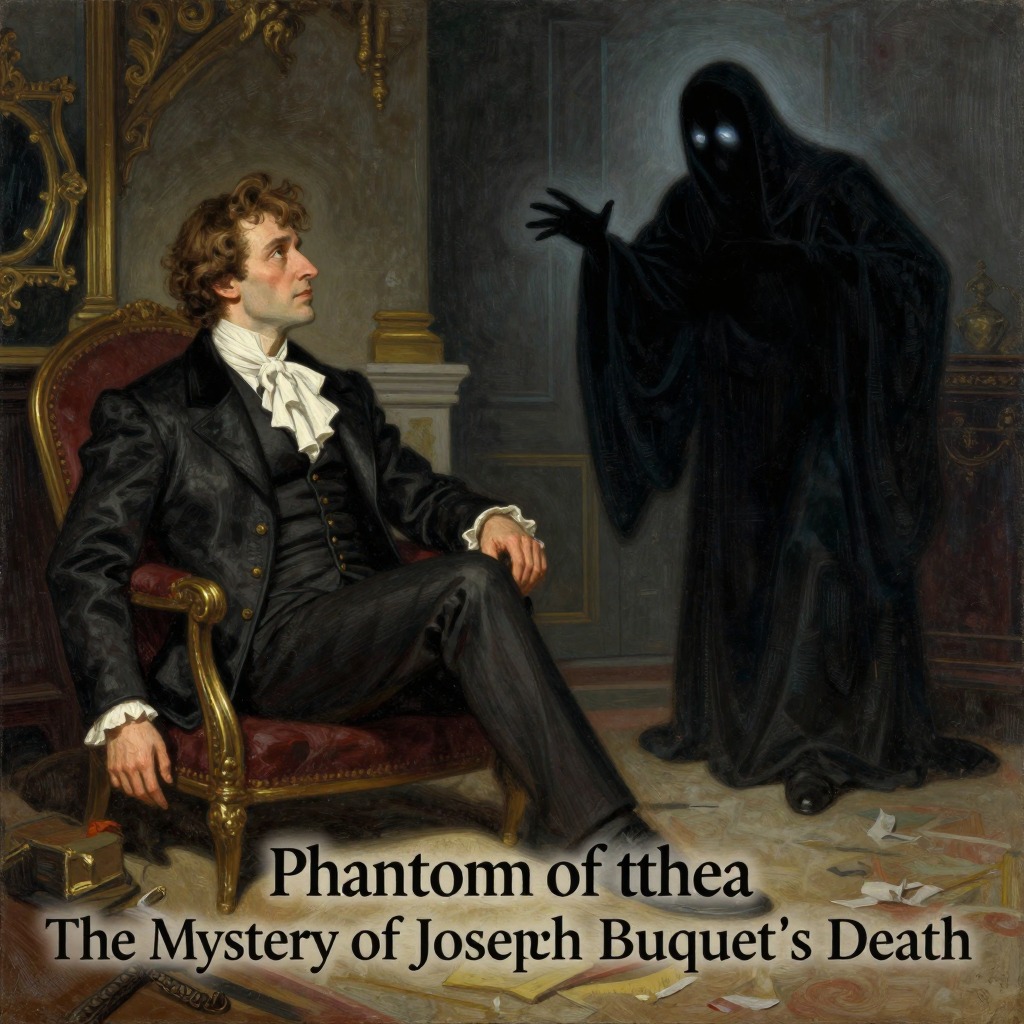
Death of Joseph Buquet
Joseph Buquet, the chief scene-shifter of the Paris Opera House, meets his end on the evening of the gala performance given by the retiring managers, MM. Debienne and Poligny. His death is announced in the dressing-room of the dancer Sorelli, where a group of ballet-girls have gathered in terror after claiming to have seen the Opera Ghost. The news arrives with the breathless entrance of little Jammes's mother, who bursts in and cries out that Joseph Buquet is dead, found hanging in the third-floor cellar. The girls, already frightened by the ghost's appearance, immediately whisper that it must be the ghost's doing, and little Giry, the daughter of the box-keeper, blurts out the accusation before clapping her hands over her mouth in a vain attempt to unsay it. Sorelli, pale and shaken, declares that she will never be able to recite her speech, while Ma Jammes, emptying a glass of liqueur, gives her opinion that the ghost must have something to do with it.
The Discovery and the Inquest
The exact circumstances of Buquet's death are never fully explained. The verdict at the inquest is "natural suicide," but the details surrounding the discovery are deeply unsettling. M. Moncharmin, one of the joint managers who succeed Debienne and Poligny, describes the incident in his Memoirs of a Manager: he is in the manager's office when Mercier, the acting-manager, rushes in, half mad, and reports that the body of a scene-shifter has been found hanging in the third cellar under the stage, between a farm-house and a scene from the Roi de Lahore. Moncharmin shouts to cut him down, but by the time he rushes down the staircase and the Jacob's ladder, the man is no longer hanging from his rope. The rope has disappeared. Moncharmin, ever the skeptic, offers a simple explanation: the ballet-girls, taking their precautions against the evil eye, must have divided the suicide's rope among themselves in less time than it takes to write. But the narrator, Gaston Leroux, finds this absurd, pointing out that the body was found in the third cellar underneath the stage, and suggests that somebody must have been interested in seeing that the rope disappeared after it had effected its purpose.
The Ghost's Hand
The ballet-girls, already primed by the ghost legend, have no doubt that Buquet's death is the work of the Opera Ghost. The ghost had appeared to them earlier that evening in the shape of a gentleman in dress-clothes, who seemed to come straight through the wall. Joseph Buquet himself had previously given a detailed description of the ghost, describing him as extraordinarily thin, with a dress-coat hanging on a skeleton frame, deep black holes for eyes, a nasty yellow skin stretched across his bones like a drumhead, and a nose so small it could not be seen side-face. The girls had also heard from little Giry that her mother, the box-keeper, believed the ghost did not like being talked about, and that Joseph Buquet had no business to talk of things that did not concern him. Little Giry, in a moment of terror, had even predicted that his talk would bring him bad luck. When the news of his death arrives, the girls' superstition seems confirmed, and the ghost's power is established as something far more sinister than a mere legend.
The Body and the Rope
The body of Joseph Buquet is later seen by Raoul de Chagny, who, after his bewildering encounter in Christine Daae's dressing-room, wanders through the theater and finds himself at the bottom of a staircase, where a procession of workmen are carrying a stretcher covered with a white sheet. When he asks what it is, the workmen answer that it is Joseph Buquet, who was found in the third cellar, hanging between a farm-house and a scene from the Roi de Lahore. Raoul takes off his hat and falls back to make room for the procession, a gesture of respect for the dead that contrasts with the superstitious terror of the ballet-girls. The rope, however, remains a mystery. The narrator notes that the exact spot where the body was discovered—the third cellar underneath the stage—suggests that somebody must have been interested in seeing that the rope disappeared after it had effected its purpose, and he promises that time will show if he is wrong.
The Persian's Revelation
Much later, the Persian's narrative sheds light on Buquet's death. The Persian, who knows Erik's secrets, explains that he found the Punjab lasso, a curious rope made of catgut, at the foot of the iron tree in the torture-chamber. He is convinced that this rope had already done duty for Joseph Buquet, who, like himself, must have caught Erik one evening working the stone in the third cellar. Buquet probably tried to use the secret entrance in his turn, fell into the torture-chamber, and only left it hanged. The Persian imagines Erik dragging the body, in order to get rid of it, to the scene from the Roi de Lahore, and hanging it there as an example, or to increase the superstitious terror that was to help him in guarding the approaches to his lair. Then, upon reflection, Erik went back to fetch the Punjab lasso, which might have set an examining magistrate thinking. This explains the disappearance of the rope. The revelation confirms that Buquet's death was not a suicide but a murder, and that the ghost, far from being a mere legend, was a flesh-and-blood killer who would stop at nothing to protect his secrets.